Impact Factor ISSN: 1449-2288


 Global reach, higher impact


Int J Biol Sci 2025; 21(5):1852-1862. doi:10.7150/ijbs.107469 This issue Cite
Research Paper
Impact of Parental Time-Restricted Feeding on Offspring Metabolic Phenotypic Traits
1. Centre for Cardiovascular Biology and Disease Research, La Trobe Institute for Molecular Science, La Trobe University, Melbourne, Australia.
2. Department of Microbiology, Anatomy, Physiology and Pharmacology, School of Agriculture, Biomedicine and Environment, La Trobe University, Melbourne, Australia.
3. Research Laboratory of Electronics, Department of Materials Science and Engineering, Massachusetts Institute of Technology, Boston, MA, USA.
4. Department of Neurology, University Medical Center Hamburg-Eppendorf, Hamburg, Germany.
5. Epigenes Australia Pty Ltd., Melbourne, Victoria, Australia.
6. Department of Neurological Surgery, University of Wisconsin, Madison, WI, USA.
7. Translational Biomedical Proteomics Laboratory, Institute of Molecular and Cell Biology, Agency for Science, Technology and Research, Singapore, Singapore.
8. Department of Anatomy, Yong Loo Lin School of Medicine, National University of Singapore, Singapore, Singapore.
9. Department of Neuroscience, Johns Hopkins University School of Medicine, Baltimore, MD, USA.
10. School of Pharmacy, Sungkyunkwan University, Suwon, Republic of Korea.
Abstract
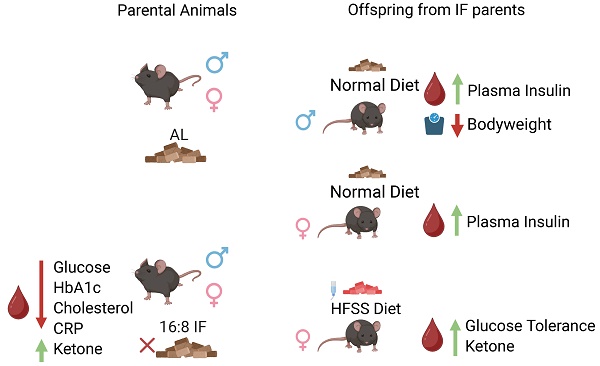
Intermittent fasting (IF) is widely recognized for its numerous health benefits, yet its impact on metabolic health across generations remains relatively unexplored. This study investigates the intergenerational effects of parental IF, specifically through 8-hour daily time-restricted feeding, on the metabolic health of offspring. By examining four different combinations of parental mating groups, we demonstrate that parental IF can influence offspring metabolic health in distinct ways. Our results reveal that parental IF conferred significant metabolic advantages compared to ad libitum (AL) feeding. IF parents exhibited lower glucose, HbA1c, cholesterol, and CRP levels, and higher ketone levels compared to AL parents. Offspring of IF-exposed animals displayed sex-specific metabolic benefits when challenged with a high-fat, high-sugar, and high-salt (HFSS) diet. Notably, female offspring from IF parents were protected against HFSS-induced glucose intolerance and exhibited lower plasma glucose levels and higher ketone levels compared to offspring of ad libitum-fed parents. Additionally, female offspring from IF parents on a HFSS diet, along with both female and male offspring on a normal diet, had elevated plasma insulin levels. Furthermore, male offspring from IF parents on a normal diet exhibited a significant reduction in body weight compared to offspring from AL parents. These findings suggest that parental IF can impart enduring metabolic benefits to offspring and may serve as an effective strategy to mitigate the risks of obesity and diabetes in future generations.
Keywords: Intermittent fasting, Metabolic Syndrome, Intergenerational inheritance